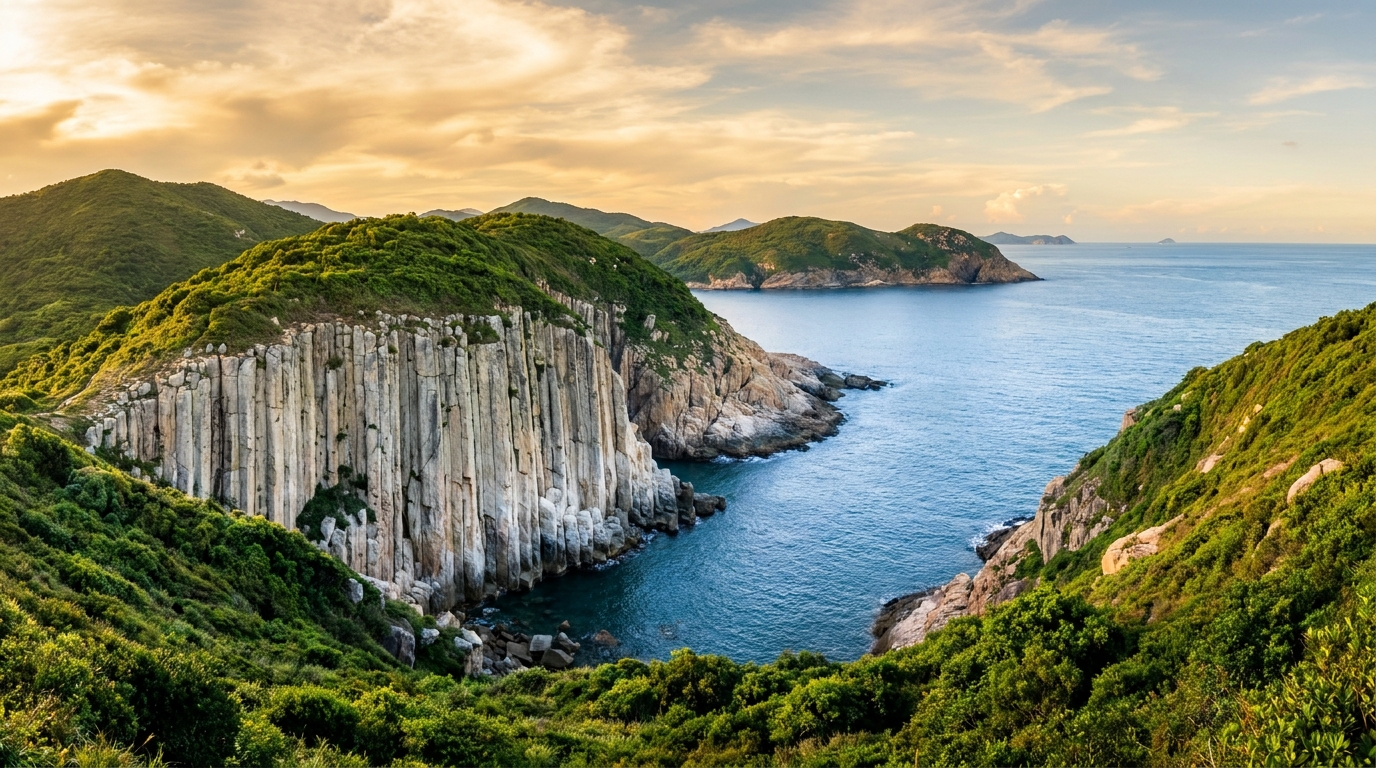
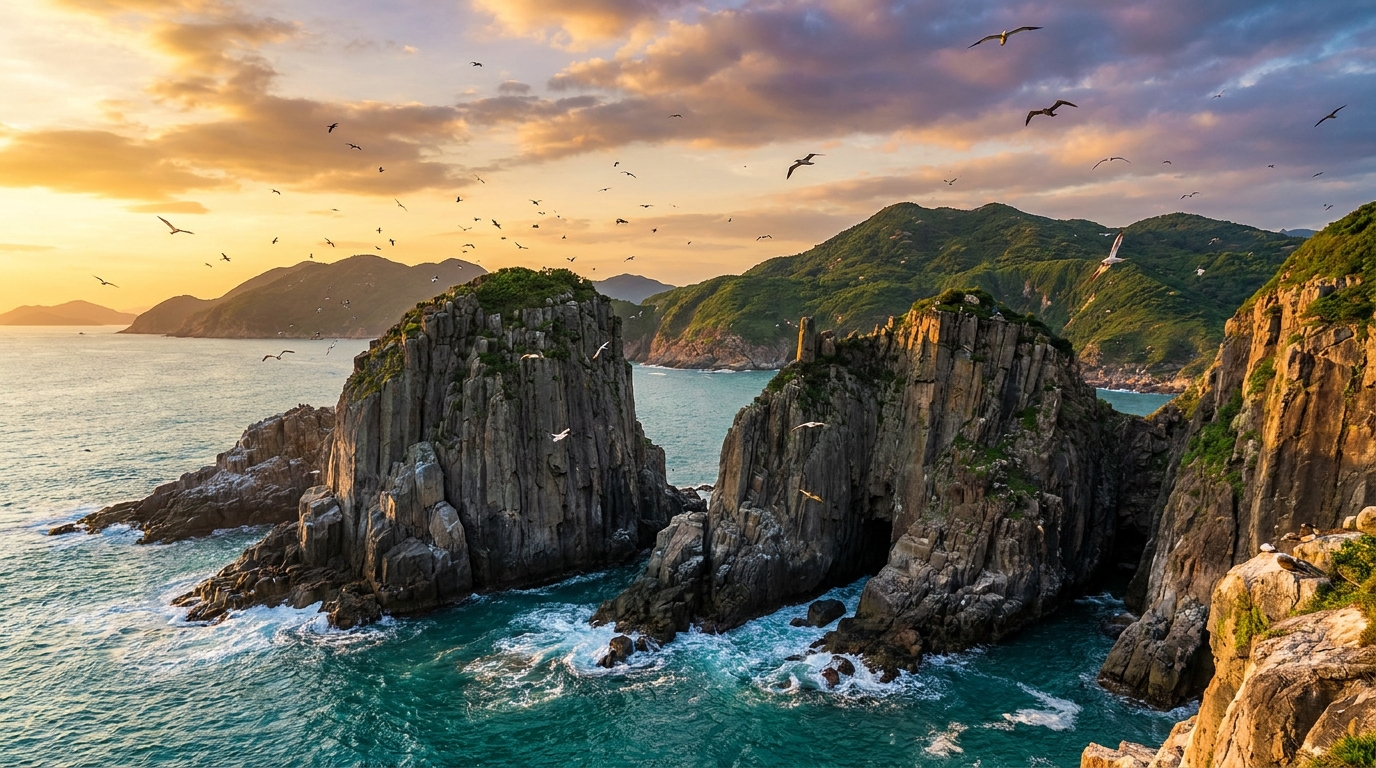
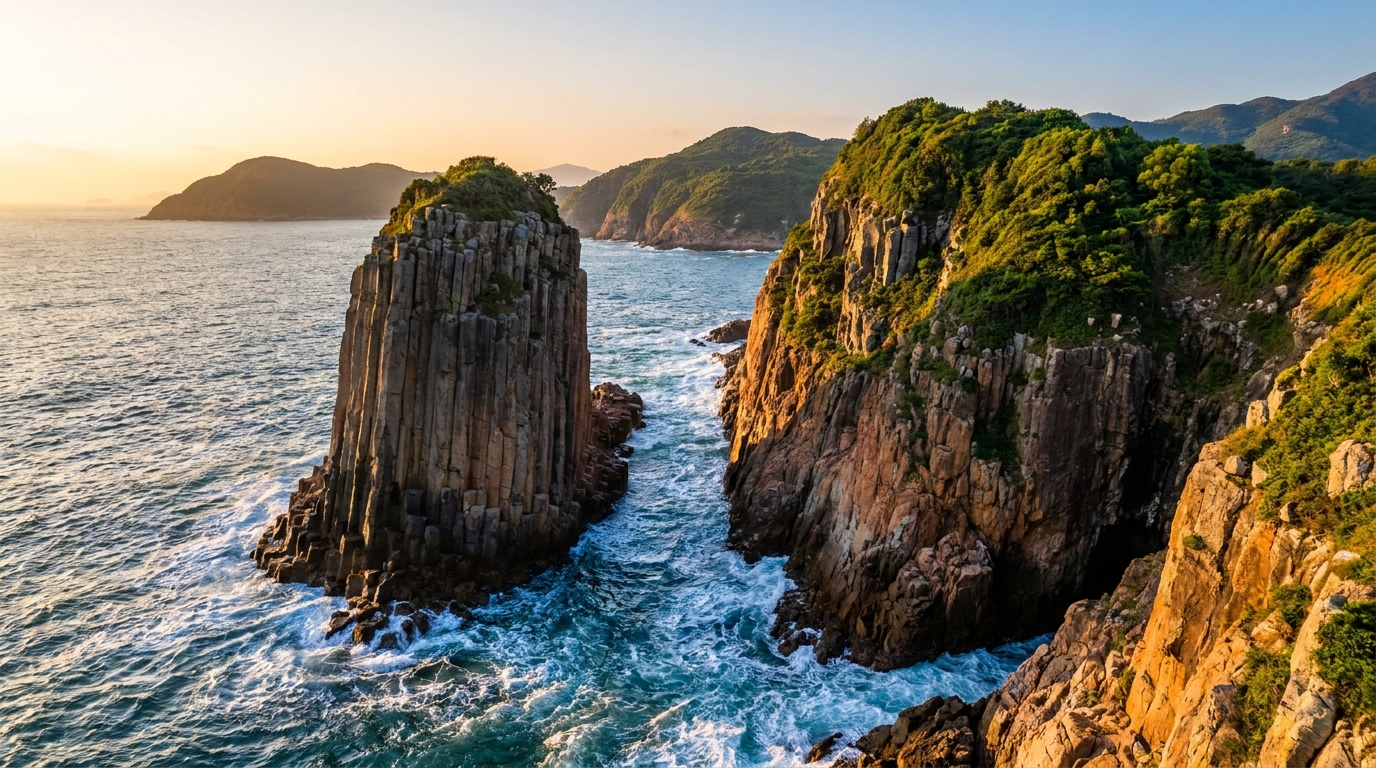
Far beyond the sheltered beaches of the inner islands, where the Hong Kong UNESCO Global Geopark meets the open South China Sea, lies one of its wildest and least-visited corners: the Ung Kong Group. These three rugged, uninhabited islands hide some of the most spectacular sea caves and arches in all of Hong Kong — cathedral-like spaces hollowed from cliffs of volcanic columns. There are no piers, no beaches and no facilities. To see them is to commit to the sea itself.
What is the Ung Kong Group?
The Ung Kong Group (甕缸群島) is a trio of islands in the outer, eastern reaches of the Sai Kung volcanic region, fully exposed to the swell rolling in from the open ocean. The three are:
- Wang Chau (橫洲) — known for its dramatic arch and the surrounding columnar coastline.
- Basalt Island / Fo Shek Chau (火石洲) — home to what is generally regarded as Hong Kong’s largest sea cave, along with soaring arches.
- Bluff Island / Ngam Tsai (尖洲) — ringed by sheer columnar cliffs and slot-like caves.
Like the rest of the geopark, these islands are built from rhyolitic volcanic rock that cooled into regular hexagonal columns roughly 140 million years ago. For the full story of how those pillars formed, see our hexagonal columns explainer. What sets the Ung Kong Group apart is what the sea has done to that rock since.
How the sea caves and arches formed
The columns themselves are riddled with natural lines of weakness — the vertical joints between pillars, and horizontal fractures crossing them. For millions of years, waves driven by the open sea have pounded these weak points, prising columns loose and excavating the rock along the cracks. Where the erosion bites into a headland from one side, it carves a sea cave. Where two caves meet through a narrow promontory, or where a cave breaks through to the far side, the roof survives as a sea arch. Continue the process and the arch eventually collapses, leaving an isolated sea stack like nearby Po Pin Chau.
The Ung Kong Group shows every stage of this drama at once. Its caves run deep and dark into the cliffs; its arches frame slices of open sky and water; and its columnar walls drop sheer into deep, surging swell. Because the rock here is so regularly jointed, the results are unusually clean and geometric — a textbook of coastal erosion written at giant scale.
What you’ll see on the water
A boat tour threads between and sometimes into these features. Highlights typically include:
Hong Kong’s largest sea cave
The standout is the great sea cave on Basalt Island (Fo Shek Chau), widely cited as the largest in Hong Kong. Skilled boat operators nose carefully toward — or briefly into — its mouth on calm days, revealing a vast, echoing chamber walled with columns. The scale is hard to convey from photographs; only from a small boat rocking in its shadow do you grasp how much rock the sea has removed.
Sea arches
Several arches punctuate the group, most famously on Wang Chau. Passing beneath or alongside an arch of stacked volcanic columns, with the open ocean visible through the gap, is the signature moment of an Ung Kong tour.
Columnar cliffs
Between the named features, the coastline itself is the attraction: continuous walls of vertical hexagonal pillars rising straight from deep water, occasionally bent or fractured by ancient earth movements, and glowing pale gold in low sun.
How to get there: licensed boat tours
There is no way to land and explore the Ung Kong Group on foot. The islands have no piers, no beaches you can safely access and no facilities, and they sit in exposed, often rough water. Realistically, there are two ways to see them.
| Option | Who it suits | Notes |
|---|---|---|
| Licensed geo-tour boat | Almost everyone | Departs Sai Kung Town; often combined with other outer islands |
| Experienced sea kayak | Skilled, equipped paddlers only | Open-water, exposed coast; calm conditions essential |
For the vast majority of visitors, a licensed boat tour is the answer. Operators run trips from the Sai Kung public pier, frequently bundling the Ung Kong Group with the Ninepin Group, Po Pin Chau and the sea caves near the High Island East Dam into a half- or full-day outing. When choosing a tour:
- Confirm the operator is licensed and the vessel is appropriate for open water.
- Ask whether they actually approach the caves and arches, or only circle the islands at a distance.
- Check the cancellation and weather policy — reputable operators will not sail in dangerous swell.
To reach Sai Kung Town in the first place, see the transport guide; note there is no MTR station in Sai Kung, so you’ll connect by bus or minibus from the city.
Best time to go
Aim for a calm, clear day with low swell. Autumn and spring generally offer the steadiest seas and best visibility; summer brings heat, haze and typhoon risk, while winter monsoon winds can whip up the open water. Because conditions out here change fast, build flexibility into your plans and expect that tours may be postponed. Our guide to the best time to visit Sai Kung has more on the seasons.
Safety on the open sea
The Ung Kong Group is genuinely exposed, and respect for the sea is non-negotiable:
- Never attempt the crossing in a small private boat or inexperienced kayak. The water near the caves can surge violently.
- Wear a life jacket at all times on the water.
- Follow the boatman’s instructions about where it is safe to approach.
- Do not enter caves unless the operator judges it safe; a passing swell can be dangerous in a confined space.
- Carry sun protection, water and motion-sickness remedies — there are no facilities and the ride can be bouncy.
Itinerary ideas
The Ung Kong Group is best experienced as part of a wider outer-islands geo-tour. A classic full-day boat trip from Sai Kung might string together the Ung Kong Group, the remote hexagonal pillars of the Ninepin Group, and the towering sea stack of Po Pin Chau beside the East Dam — a single voyage through the most dramatic coastal geology in Hong Kong. Round off the day back in Sai Kung Town with a well-earned seafood dinner on the waterfront.
Frequently asked questions
Can I visit the Ung Kong Group on my own?
Not easily. The three islands are remote, exposed and have no piers or facilities, so they are realistically reached only by a licensed boat tour from Sai Kung Town or by experienced sea kayakers in calm conditions.
What is the largest sea cave in Hong Kong?
It is generally said to be on Basalt Island (Fo Shek Chau) in the Ung Kong Group. The caves and arches were carved by waves cutting along weaknesses in the volcanic hexagonal columns.
When is the best time to take a boat tour?
Go on a calm, clear day with low swell, ideally in autumn or spring. The open sea around the outer islands can become rough quickly, and tours are cancelled in poor conditions.