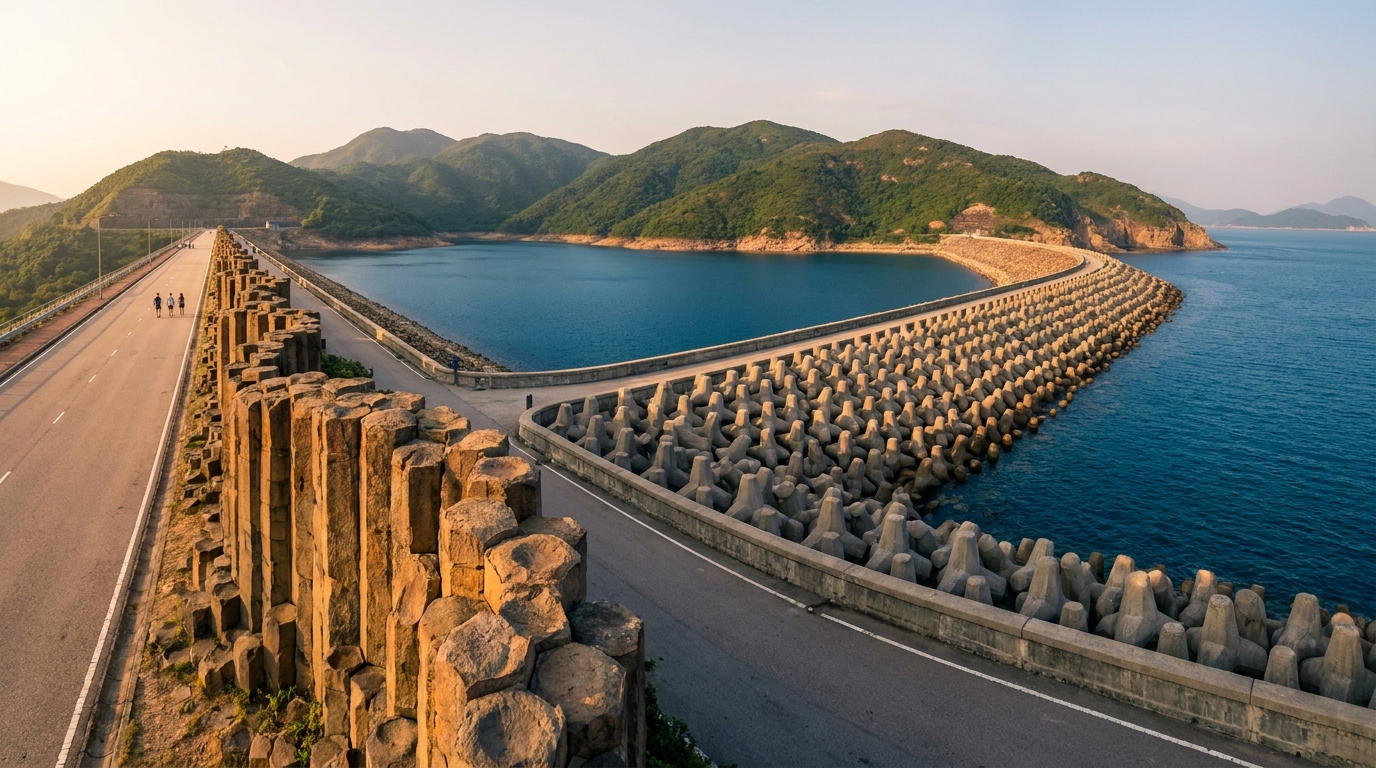
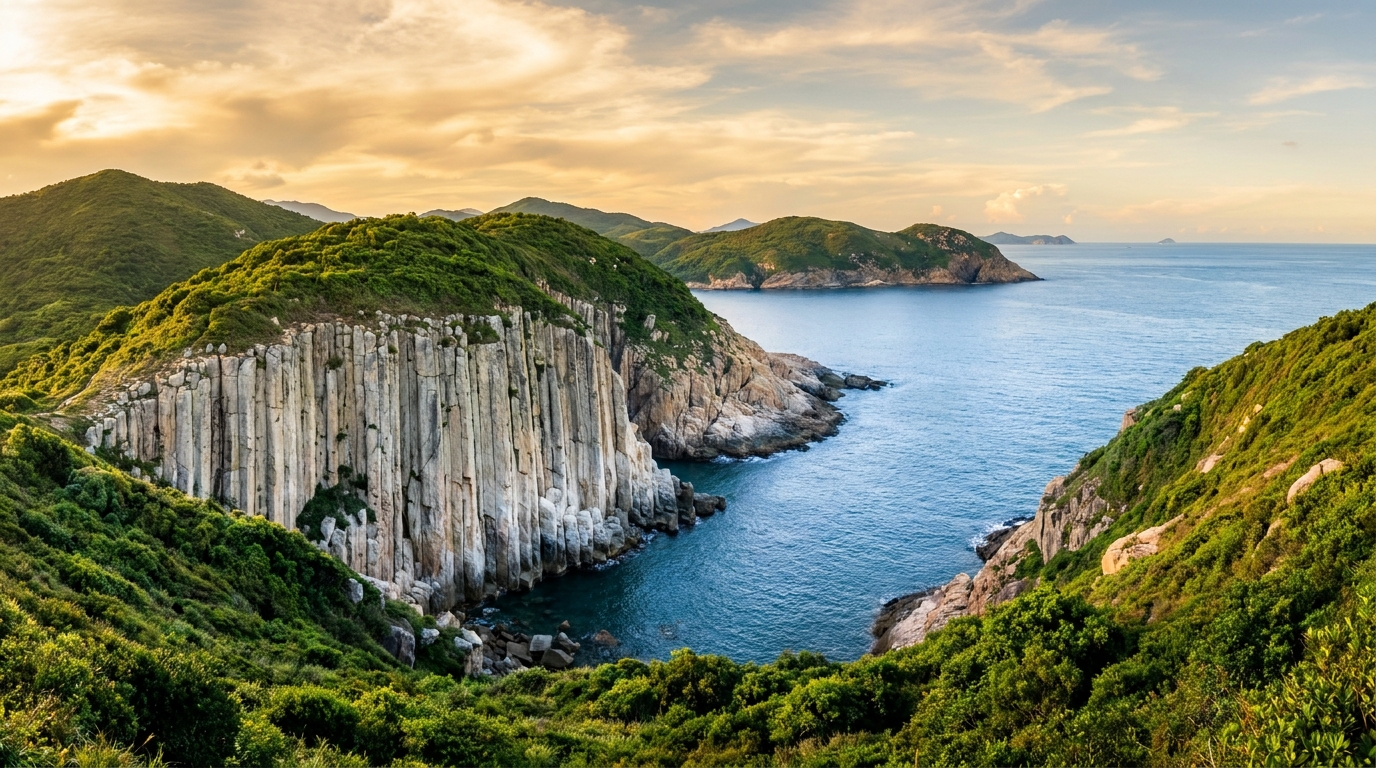
Stand at the foot of the cliffs at Sai Kung’s East Dam and you are looking at one of the strangest things solid rock can do: split itself, all on its own, into tall, near-perfect hexagonal pillars. They look manufactured, even sculpted — yet no chisel ever touched them. The truth is stranger and grander: these columns are the frozen fingerprint of a supervolcano that erupted around 140 million years ago, and the slow, patient physics of cooling rock. This guide explains how they formed, why they are so unusual, and where to see them across the Hong Kong UNESCO Global Geopark.
A supervolcano, 140 million years ago
In the Early Cretaceous, long before Hong Kong existed in any recognisable form, this corner of South China sat over a violently active volcanic system. The eruption that built the columns was not a gentle ooze of lava. It was a cataclysm — a supervolcanic eruption that blasted out staggering volumes of hot ash and pumice, so much that the ground above the emptied magma chamber collapsed inward to form a vast caldera.
That collapsing caldera trapped an enormous, thick sheet of super-hot volcanic ash, hundreds of metres deep in places. Crucially, the ash was so hot and densely packed that the particles fused back together into a solid mass of volcanic rock — a process geologists call welding. It is this thick, welded ash sheet, cooling inside its caldera, that became the raw material for the columns.
The science of columnar jointing
Here is the key idea: hot rock expands; cooling rock contracts; and rock that cannot contract freely must crack.
When the welded ash sheet began to cool, it shrank. But a thick body of rock does not cool all at once — it loses heat from its surfaces inward, so cooling fronts move slowly through the rock over months, years, even decades. As each layer cooled and contracted, the rock pulled on itself from all directions. The stress had to be released somewhere, so the rock fractured.
Why hexagons? Nature is economical. When cooling is slow and even, the cracks arrange themselves into the pattern that relieves the most stress for the least total crack length — and for spacing of fracture points across a plane, that ideal pattern is a grid of regular hexagons, meeting at clean 120-degree angles. (Where cooling was less uniform, you also find pentagons, four-sided and seven-sided columns mixed in.) These fractures then propagated downward, perpendicular to the cooling surface, slicing the rock sheet into vertical columns like a tray of cooling mud cracking into tiles — but in three dimensions, and at vast scale.
The slower and more uniform the cooling, the larger and more regular the columns. Sai Kung’s exceptionally thick, evenly cooling ash sheet is exactly why its columns are so tall, so regular, and so widespread.
Why rhyolite, not basalt — and why that matters
This is the single fact that makes Sai Kung world-class. Almost every famous set of columns on Earth is made of basalt — the dark, iron-rich, low-silica lava that flows runny and fast from volcanoes like those in Iceland and Hawaii. The Giant’s Causeway, Devils Postpile, the Isle of Staffa: all basalt.
Sai Kung’s columns are rhyolite. Rhyolite is the opposite kind of volcanic rock: pale-coloured and very rich in silica. Silica-rich magma is thick, sticky and gas-charged, which is exactly why it tends to erupt explosively as ash rather than flow as lava. Because of that, rhyolite very rarely forms tidy columns at all — and when it does, almost never on the scale seen here.
| Feature | Sai Kung columns | Typical columns elsewhere |
|---|---|---|
| Rock type | Rhyolite (acidic, high silica) | Basalt (basic, low silica) |
| Colour | Pale grey / light | Dark grey to black |
| Source | Welded explosive ash | Cooled lava flow |
| Rarity | Globally rare | Relatively common |
Add to that the scale — Sai Kung’s columnar rocks cover roughly 100 square kilometres, the largest such expanse anywhere on Earth — and individual columns averaging about 1.2 m across and reaching tens of metres tall, and you have a formation of genuine world significance.
Folded, tilted and carved by time
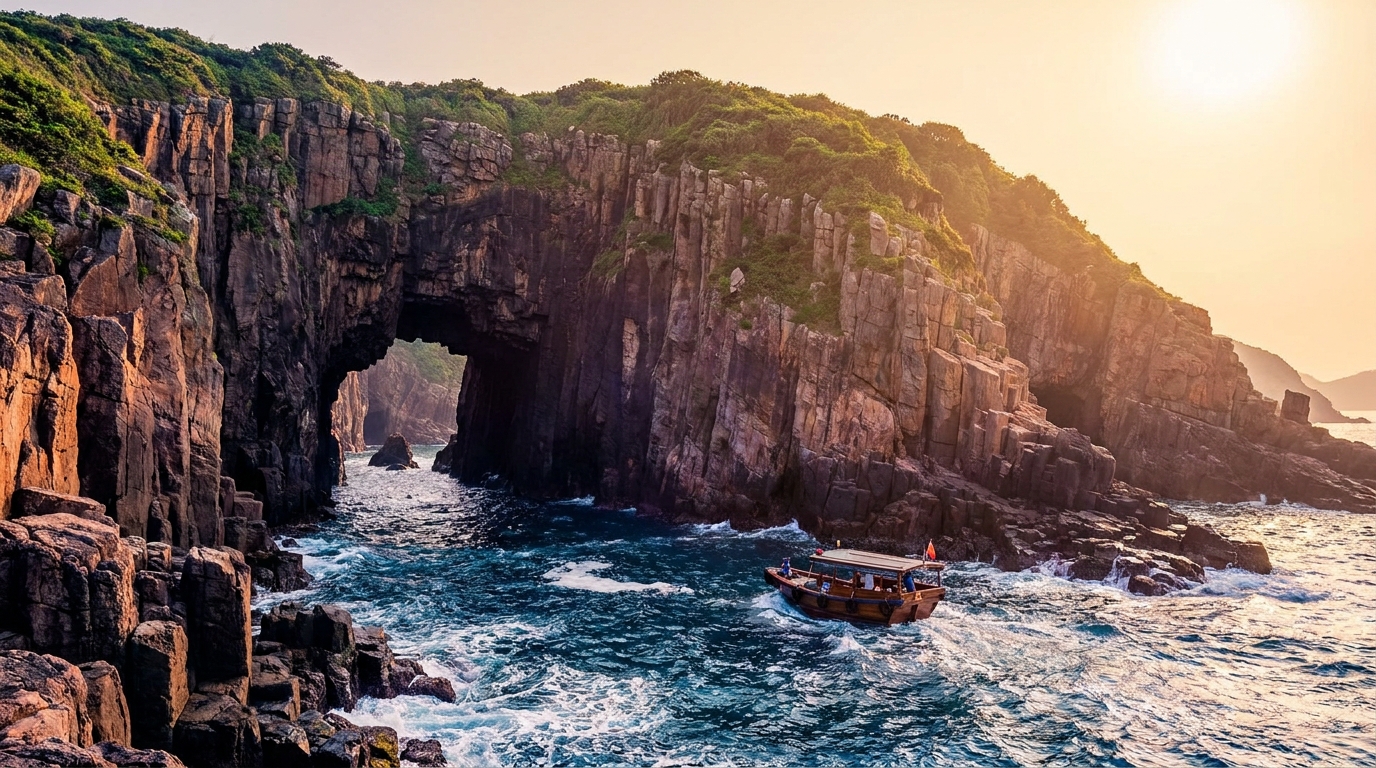
The columns did not stay pristine. Long after the rock set, tectonic movements bent and tilted whole sections of the formation, most spectacularly into the famous S-shaped fold at the High Island East Dam — proof that even ranks of solid stone pillars can be deformed like soft clay under enough pressure over enough time. Then the sea went to work, carving the exposed coast into sea caves, arches and sheer stacks, most dramatically around the Ung Kong Group and at Po Pin Chau.
Global recognition: an IUGS First-100 site
The scientific community has taken note. The Early Cretaceous rhyolitic columnar rock formation of Sai Kung was selected as one of the First 100 Geological Heritage Sites designated by the International Union of Geological Sciences (IUGS) — an inaugural global shortlist of the most scientifically important geological sites on the planet. It places Sai Kung in the same company as the world’s premier geological landmarks, and underlines that what looks like a scenic day trip is, to a geologist, a site of international importance.
How Sai Kung compares to the world’s famous columns
It helps to put Sai Kung in context:
- Giant’s Causeway (Northern Ireland) — the world’s most famous columns, but basalt, around 40,000 columns, far smaller in extent than Sai Kung.
- Devils Postpile (California, USA) — a striking but compact wall of basalt columns.
- Fingal’s Cave, Staffa (Scotland) — beautiful basalt columns forming a sea cave.
Each is justly celebrated — yet all are basalt, and none approaches Sai Kung’s combination of rhyolitic composition and 100 km² scale. In short, the world has many basalt causeways; it has only one Sai Kung.
Where to see the columns in Sai Kung
You do not need to be a geologist to be floored by them. The best places:
- High Island Reservoir East Dam — the only place you can stand right beside the columns and see the S-fold up close. Start here.
- Sharp Island — accessible by a short kaito ferry, with columnar rock and a tombolo sandbar.
- Ung Kong Group — offshore sea caves and arches cut through towering column cliffs, seen by geo-tour boat.
For the full picture of the park, its two regions and responsible-visit rules, read the Hong Kong UNESCO Global Geopark overview. To plan the journey from the city, see our transport guide. Once you understand what you are looking at — a 140-million-year-old volcanic catastrophe, frozen mid-crack and folded by tectonics — the cliffs of Sai Kung stop being merely scenic and become genuinely astonishing.
Frequently asked questions
Why are Sai Kung's columns rhyolite and not basalt?
Most columns elsewhere — like the Giant’s Causeway — are basalt, a dark, low-silica lava. Sai Kung’s were made from thick, silica-rich rhyolitic ash from an Early Cretaceous supervolcano, which is why they are pale and globally rare. See the geopark overview for the big picture.
Why are the columns hexagonal?
As thick volcanic rock cools and contracts, it cracks. When cooling is slow and even, the cracks self-organise into the most efficient pattern for releasing stress — regular polygons, most often hexagons.
Where is the best place to see them?
The High Island Reservoir East Dam is the best spot to stand beside the columns. They also appear around Sharp Island and the Ung Kong Group by boat.