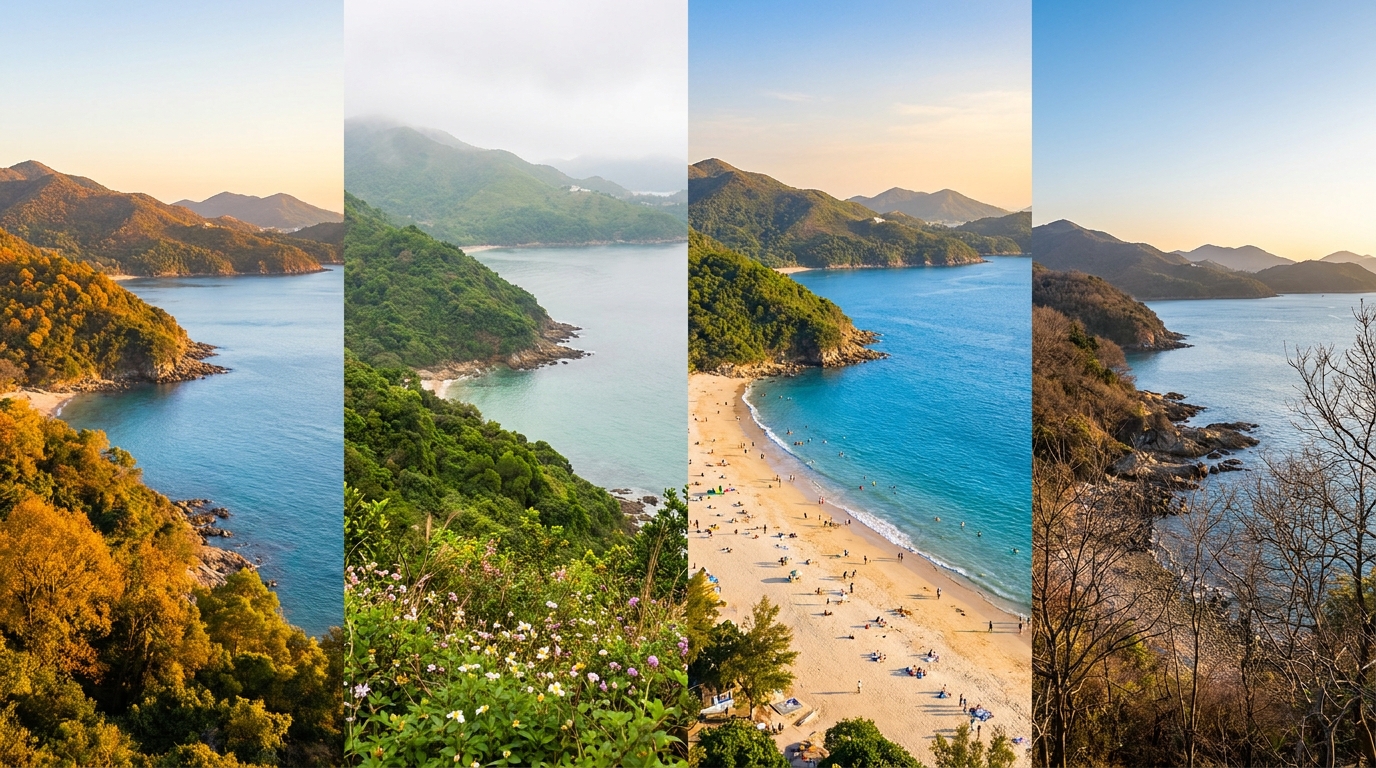
Few things shape a day out in Sai Kung more than the weather. Hong Kong has a humid subtropical climate with four distinct seasons, and Sai Kung’s exposed eastern coast, islands and hills add their own twists — more wind, bigger swell and cooler, mistier peaks. This guide explains what to expect through the year, how Hong Kong’s warning systems work, and exactly where to check the forecast before you go.
Hong Kong’s climate in a nutshell
Hong Kong sits just south of the Tropic of Cancer, so summers are long, hot and humid, and winters are short and mild. The East Asian monsoon drives the pattern: warm, wet south-westerly air in summer; cooler, drier north-easterly air in winter. Rain is heavily concentrated in the warm months, and humidity is high for much of the year.
Season by season
| Season | Months | Typical temp | What it’s like |
|---|---|---|---|
| Spring | Mar–May | 18–27°C | Mild but humid and often misty; sea fog and drizzle |
| Summer | Jun–Aug | 26–33°C | Hot, very humid, frequent showers and thunderstorms; typhoon season |
| Autumn | Oct–early Dec | 19–28°C | Sunny, dry, clear and comfortable — the best season |
| Winter | Dec–Feb | 12–20°C | Cool, dry, sometimes grey; cold fronts can feel chilly on the hills |
Spring (March–May). Temperatures climb and the air turns humid. Expect fog and low cloud, especially on the hills and along the coast, plus spells of drizzle. Visibility for views can be hit-or-miss, but the countryside is lush and green.
Summer (June–August). Hot and sticky, with temperatures often above 30°C and humidity to match. Afternoon showers and thunderstorms are common, and this is the core of typhoon season. It’s also beach season for Tai Long Wan and Sai Wan — just start early, carry plenty of water, and watch the sky.
Autumn (October–early December). The sweet spot. Humidity drops, skies clear, and temperatures are perfect for the MacLehose Trail and the Hong Kong UNESCO Global Geopark. This is when the hexagonal columns and island views look their sharpest — see our guide to the best time to visit Sai Kung.
Winter (December–February). Cool, dry and often clear. Daytime is mild, but a cold front can drop temperatures into single digits, and it feels colder and windier on exposed ridges like Sharp Peak. The sea is too cold for most swimmers, but it’s excellent weather for walking and exploring Sai Kung Town.
Typhoons and rainstorm warnings
Hong Kong has a clear public warning system run by the Hong Kong Observatory (HKO). Two sets of warnings matter most for visitors:
Tropical cyclone (typhoon) signals: No. 1 (standby), No. 3 (strong wind), and No. 8, 9 and 10 (gale to hurricane force). At No. 8 or above, public transport winds down, ferries stop, beaches close and most people stay indoors. Never attempt a Sai Kung boat trip or coastal hike with a typhoon signal up.
Rainstorm warnings: Amber, Red and Black, in increasing severity. Red and Black mean heavy, persistent rain with flash-flooding and landslip risk — a serious hazard on hill trails and stream crossings like the pools at Sai Wan.
If a signal is hoisted, change your plans. The geopark and back-country beaches will still be there on a clear day.
Checking the forecast for Sai Kung
Here’s the catch: Sai Kung has no weather station of its own. For a local read, the nearest reliable proxy is Ma On Shan — the town and 702-metre peak immediately to the west of the district, sharing the same eastern-New-Territories weather.
Before any hike or boat trip, cross-check two sources:
- The Ma On Shan forecast on 天氣.com.hk — the closest point forecast to Sai Kung.
- The wider Hong Kong weather overview for the territory-wide picture, alongside the official Hong Kong Observatory warnings.
Sunrise and sunset
Sai Kung’s east-facing coast makes it one of the finest corners of Hong Kong for a sunrise over the open sea — and its hilltops and harbour catch warm sunset too. Times shift noticeably with the season: around the summer solstice the sun rises near 5:40am and sets close to 7:10pm, while in midwinter sunrise is around 7:00am and sunset near 5:50pm.
- Best for sunrise: the grassy hilltops of Tap Mun, the summit of Sharp Peak, and the open beaches of Tai Long Wan — all facing east over the sea.
- Best for sunset: the Sai Kung Town waterfront and west-facing country-park ridges.
- Golden hour — the hour after sunrise and before sunset — gives the warmest light on the hexagonal columns and is prime time for photography.
Always check the day’s sunrise and sunset times before a dawn hike or a stay at one of Sai Kung’s campsites, and carry a head-torch for the walk in or out in the dark.
What to pack
- Year-round: sun protection (the UV index is high, especially May–September), water, and a light rain layer.
- Summer: quick-dry clothing, extra water, and a flexible plan in case of storms.
- Autumn/winter: layers for cool mornings and breezy ridges; a windproof for exposed coast and peaks.
- Always: check the forecast and warnings the morning you travel — see how to reach the district in our transport guide.
Get the timing right and Sai Kung rewards you with clear seas, golden light and empty trails. Plan around the seasons, respect the warnings, and check the Ma On Shan forecast before you set out.
Frequently asked questions
What is the best weather for visiting Sai Kung?
Autumn (late October to December) brings Sai Kung’s best weather — clear, dry, sunny skies with comfortable temperatures and low humidity, ideal for hiking and the geopark. Spring is mild but misty, summer is hot and stormy, and winter is cool and dry.
When is typhoon season in Hong Kong?
Tropical cyclone (typhoon) season runs roughly from May to November, peaking from July to September. When the Hong Kong Observatory raises a No. 8 signal or higher, ferries and outdoor activities stop, so always check before heading to Sai Kung’s coast or islands.
Does it ever snow or get very cold in Sai Kung?
It never snows. Winter is mild, usually 12–20°C, though strong cold fronts can briefly push temperatures into single digits, and it feels noticeably cooler and windier on exposed peaks and the eastern coast.
Where can I check the weather for Sai Kung specifically?
Sai Kung has no weather station of its own, so the nearest reliable proxy is Ma On Shan, immediately to the west. Check the live Ma On Shan forecast at 天氣.com.hk alongside the official Hong Kong Observatory warnings before any hike or boat trip.