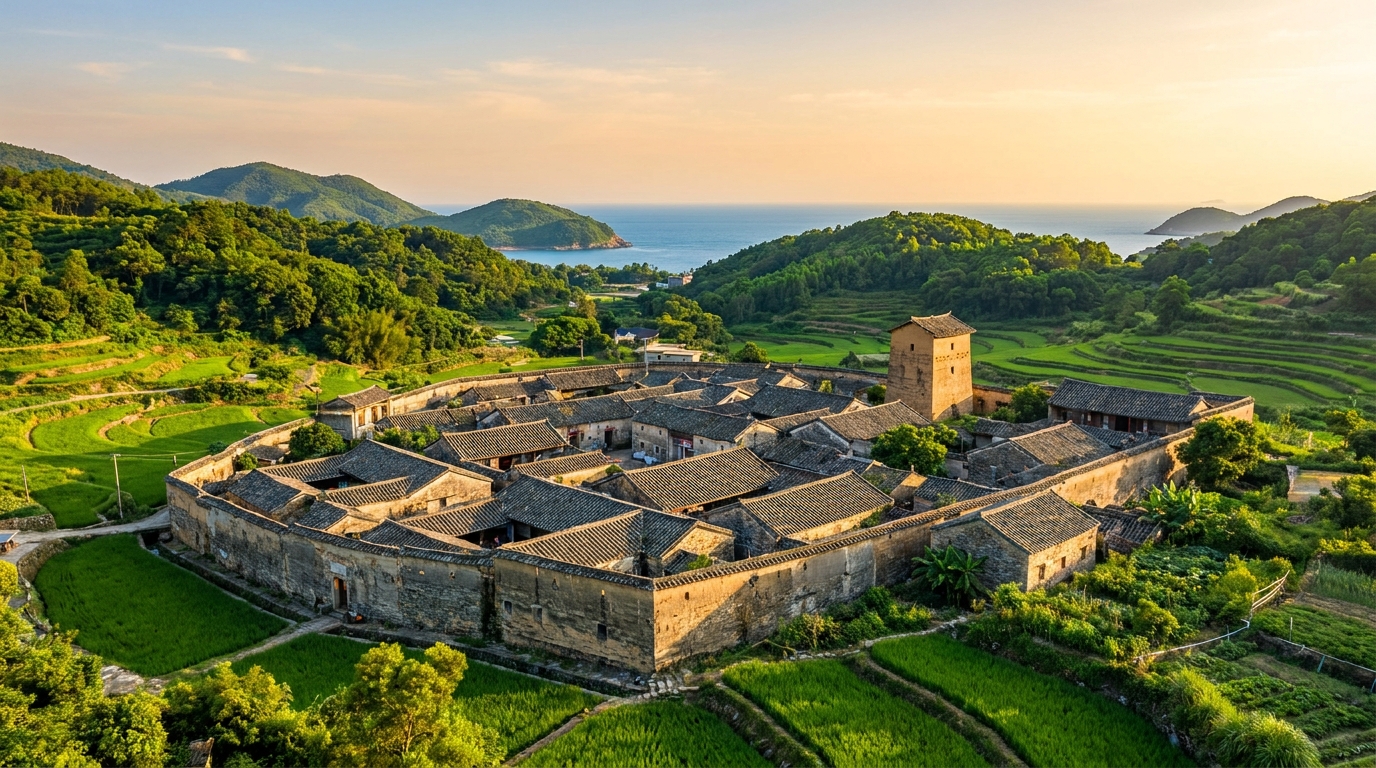
A short, shaded walk from the trailhead at Pak Tam Chung leads to one of Hong Kong’s most quietly rewarding heritage sites: a complete 19th-century fortified Hakka village, walled, towered and restored, sitting almost exactly as it did when its last families farmed and burned lime here. This is the Sheung Yiu Folk Museum.
A village frozen in time
Sheung Yiu (上窰) was built around the 1840s by the Wong family, Hakka settlers who came to Sai Kung to work the land and, crucially, to burn lime. For a few generations they prospered, then — like so many rural communities across the New Territories — the village emptied as the 20th century drew its people toward city wages and overseas opportunity. By the time it was studied and restored, Sheung Yiu had become a remarkably intact example of a small, self-contained Hakka settlement, and in 1981 it was declared a monument and opened as a branch museum.
What makes the site so valuable is its completeness. Many old villages survive only as scattered ruins or a single restored house. Sheung Yiu preserves the whole package — the defensive wall, the watchtower, the row of dwellings, the open forecourt, the cooking and farming gear, and the industrial lime kiln that paid for it all — letting you read an entire way of life in one compact, well-labelled spot.
What to see
The fortified layout
Sheung Yiu was built for security. In an era of pirates and clan feuds, even a modest Hakka village protected itself behind a defensive perimeter wall with a single guarded entrance and a corner watchtower (碉樓). Standing in the forecourt, you can immediately grasp how the community was designed to be sealed and defended after dark — a vivid reminder that 19th-century rural Sai Kung was no idyll, but a frontier that demanded vigilance.
The raised village house
Behind the wall runs a row of village houses set on a raised platform above the surrounding ground — a practical response to damp and flooding. Several rooms have been furnished to show domestic Hakka life: the kitchen with its wood-fired stove, the bedrooms, the family hall, and the everyday tools of cooking, weaving and washing. It is an unusually honest portrait of how a hardworking farming family actually lived, free of romanticised gloss.
The lime kiln
The most distinctive feature is the lime kiln just outside the village. The Wong family’s living came largely from burning seashells and coral to produce lime, an essential commodity used for building mortar, whitewash, fertiliser and even tanning. The restored kiln, and the displays explaining the process, reveal the small-scale rural industry that supported the village — a side of Hakka life often overlooked in favour of pure farming.
The exhibits
Throughout the houses you’ll find exhibits of Hakka farming and domestic culture: ploughs and harrows, fishing and rice-husking equipment, household furniture, and panels explaining Hakka customs, dress and beliefs. Together they turn the village from a pretty old building into a genuine open-air ethnographic museum of rural Sai Kung.
Why it matters
Sheung Yiu is more than a photogenic ruin. It is one of the clearest windows we have into the Hakka heritage of Sai Kung — the people who, alongside the boat-dwelling fishing families, made up the district’s traditional population. Where the fishermen prayed at the Tin Hau temples, the Hakka cleared terraces, burned lime and built walled villages like this one across the hills. Seen together, the two communities explain how Sai Kung lived before the country parks and the seafood restaurants. For the wider story, read our guide to the Hakka villages of Sai Kung.
How to get there
The museum is reached on foot from the Pak Tam Chung gateway — there is no separate car park or bus stop at the village itself.
| Step | How |
|---|---|
| 1. City to Sai Kung Town | KMB bus 92 from Diamond Hill MTR, or minibus 1A from Choi Hung MTR |
| 2. Sai Kung Town to Pak Tam Chung | Country-park bus 94 (daily) or 96R (Sundays & holidays) |
| 3. Pak Tam Chung to the village | Walk the flat Pak Tam Chung Nature Trail, about 15–20 minutes |
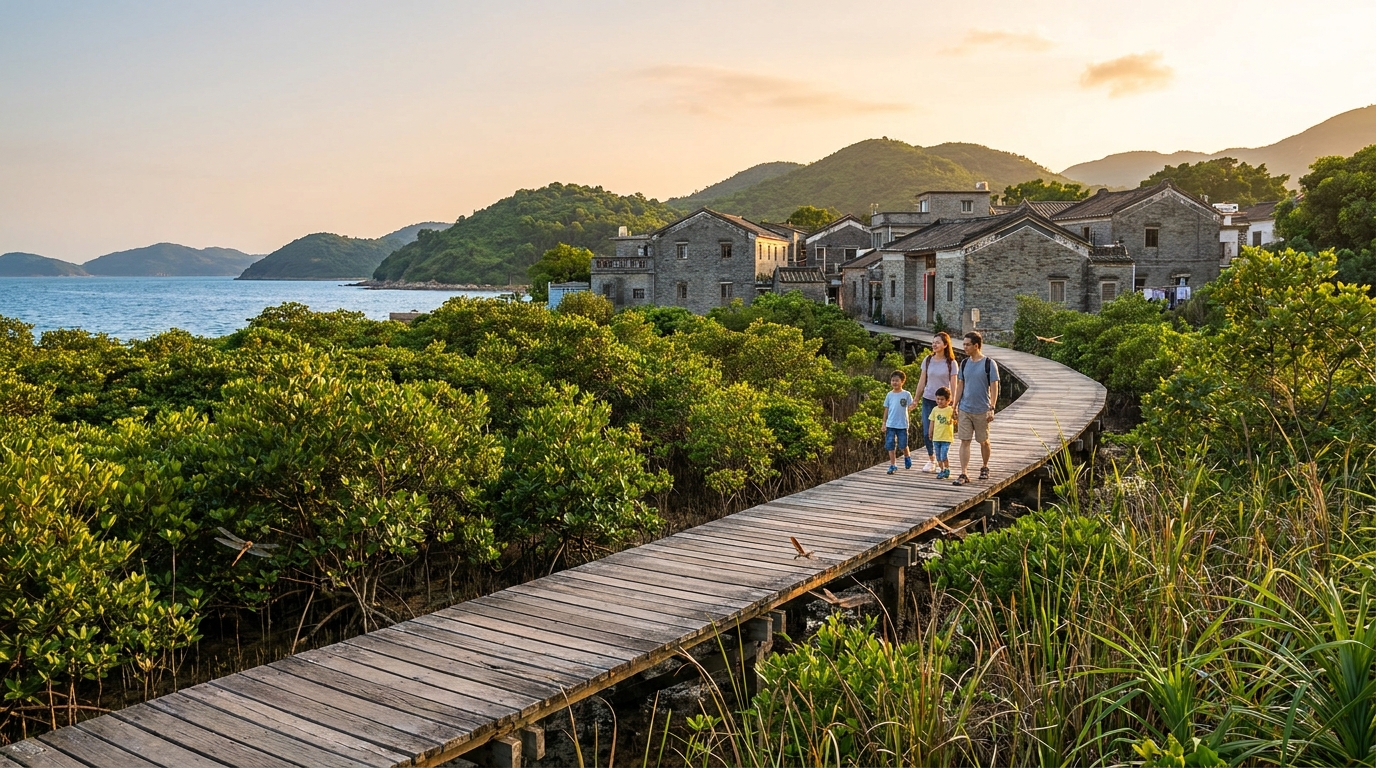
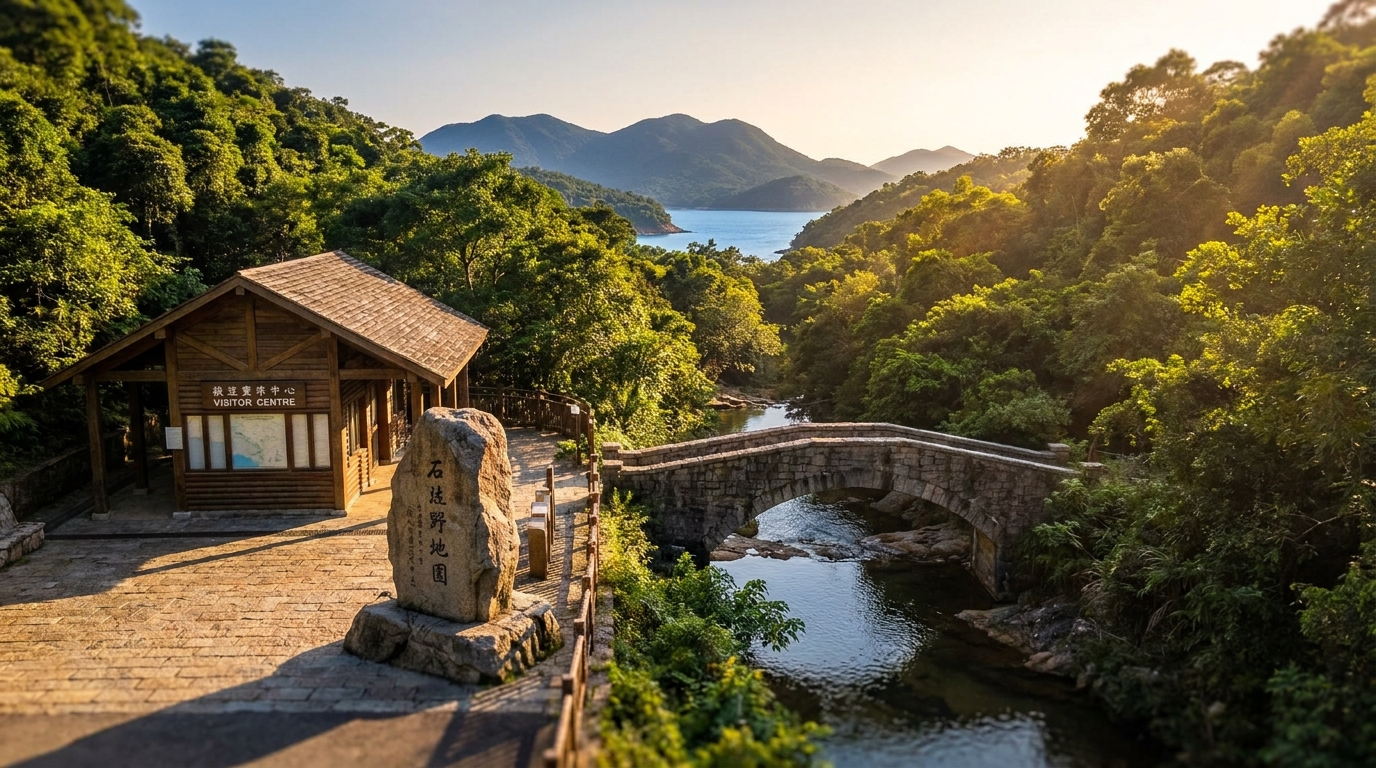
From the city, the simplest route is KMB bus 92 from Diamond Hill MTR (Exit C2) to Sai Kung Town, about 45–60 minutes, or the frequent green minibus 1A from Choi Hung MTR (Exit C2). At Sai Kung Town, transfer to a country-park bus toward Wong Shek and alight at Pak Tam Chung. From there, follow the signed Pak Tam Chung Nature Trail — a gentle, mostly flat path past mangroves and a stream — straight to the village. See the full getting to Sai Kung guide for timings; Octopus is accepted on the buses.
Best time to visit
- Autumn and winter (October–March) bring the coolest, clearest weather and the most pleasant walk in.
- Weekday mornings are quietest; weekends add the 96R bus but also more visitors at the gateway.
- The site closes on certain days each week (typically a midweek closure plus some public holidays), so plan around opening days and aim to arrive with time to walk in and back.
- Pair it with a longer outing in autumn, when the surrounding country park is at its best.
Practical tips
- Admission is free — bring your curiosity, not your wallet.
- Wear comfortable shoes; you still have a short trail walk in each direction.
- Bring water, especially in warm months — there is little for sale beyond the gateway.
- Photography is generally fine, but be gentle with the old structures and exhibits.
- Allow 30–45 minutes at the village, more if you combine it with the full nature trail.
- Take all litter home to help keep the country park pristine.
Make a half-day of it
Sheung Yiu is ideal as the highlight of an easy half-day. Start at the Pak Tam Chung visitor centre to get your bearings, amble the nature trail to the village, then return for a country-park bus and a seafood lunch back in Sai Kung Town. It is one of the few places in Hong Kong where you can walk straight into a fully preserved 19th-century world — for free, in under an hour from the bus stop, and with the wild beauty of Sai Kung all around you. Plan your trip with the transport guide.
Frequently asked questions
Is the Sheung Yiu Folk Museum free to visit?
Yes, admission is free. It is a public heritage site reached on foot via the short Pak Tam Chung Nature Trail from the country park visitor centre.
How do I get to Sheung Yiu Folk Museum?
Reach Pak Tam Chung first, then walk about 15–20 minutes along the flat nature trail to the village. From the city, take bus 92 from Diamond Hill MTR to Sai Kung Town, then a country-park bus.
What is special about Sheung Yiu?
It is a rare, intact 19th-century fortified Hakka village — a declared monument — that has been restored as a museum, complete with a watchtower, a row of village houses, farming tools and a large lime kiln.